
Reviews
PIECES OF MUSIC AND LIFE
Artvoice feature by Manya Fabiniak
Photographer Irene Haupt has created for herself a unique position in the arts of this community. As an artist she has won numerous awards for her work throughout the years, while as a career woman she has helped to document an aspect of the very culture of which she is an integral part. he has worked for, or with, such notable institutions in Buffalo as the Irish Classical Theatre, Studio Arena Theater, the Kavinoky theatre, the Buffalo Philharmonic Orchestra, and the Albright-Knox Art Gallery.
Irene Haupt has also documented the contemporary music scene in Buffalo, most notably the June in Buffalo Festival of New Music at the State University of New York at Buffalo from 1982-1987, and 2000 to the present. Over the course of those years she has created a visual record of images of some of the most significant composers and performers of the last quarter century. It is for this reason that Haupt was honored with an exhibition of her work at UB’s Music Library as part of Gender Week 2004: Women at Work. According to Associate Librarian John Bewley, “We wanted to honor Irene because I believe we are very lucky to have this documentation by her of over several hundred images of composers, performers, and local UB musicians.”
The exhibit displayed photographs of these artists in both posed and un-posed shots, including those taken during lectures, rehearsals and concerts. One senses the photographer’s appreciative and warm approach as a number of subjects come forth with such a relaxed air, perfectly content to be who and where they are at that particular moment. Looking up from his sheet music, the composer Virgil Thomson is pure charm in his polka dotted bow tie and checkered jacket. “The images speak in a way that programs and paper documents don’t”, Bewley remarks. “You look at this picture of Ralph Shapey and you catch his vivacity”, and, pointing to another photo, “George Crumb is a sweet man, and he comes across as this. You see how different they are; their personalities come through. It’s important for us to have these historical documents, and people just enjoy it!”
The composer and pianist Leo Smit was honored with several photos in the exhibit, each providing further insight into the man’s humanity. Yet Haupt understands the value of being more bold and direct. Pauline Oliveros, known for her meditative theory of “Deep Listening”, confronts the viewer with eyes of fierce and solid intensity as she plays her instrument. Elsewhere composer Charles Wuorinen , with somewhat grave, narrowed eyes, pierces the veil between lens and photographer.
The camera, of course, can be quite unforgiving as it reveals every sign and nuance of age as time marks us. This can certainly be seen in the semi profile photo of Lukas Foss, where rivers of deep, craggy lines rise up his cheeks to tighten and converge at the source of their expression. Yet as Foss seems to be in mid sentence, Haupt captures an exuberance of spirit that flows effortlessly from this man’s smile, transmuting his age to agelessness.
Irene Haupt’s personal response to her work speaks of and for a passion that is part of the core of Life. “I love the energy of new music, the experience that composers provide when it’s fresh off the press. One can experience the first draft and next year the rewritten piece. It allows the audience to become a part of the composer’s creative process. “
” Felder’s piece Boxman is very witty and clever,” she continues, “and you witnessed the creative evolution of that piece because it was played with different people at different times. It’s just exciting to be a part of that. To me it’s about the joy of being alive, because I’ve had the experience of witnessing someone dying, to literally see the light go out in their eyes. You come to appreciate life energy. I always look for that life energy, and that’s why I can’t understand how people can send their loved ones to war to die … .that is so totally perverse to me.”
Also included in the exhibit are selections of Haupt’s work that highlight the breadth of her photography. Viscaya Staircase presents a large composition of multiple layers built up to a luscious richness of gold, amber, and vermillion. With each overlay of film the staircase slightly shifts as it sharply ascends up its narrow confines. A deep cobalt blue seeps in on the corners, seemingly corroding, dissolving the scene into an eventual dark and endless void. Within this multidimensional reality nothing is static or assumedly ever solid.
“None of my photos are one-dimensional flat surfaces,” explains Haupt. “There always is a 3 dimensionality of looking through several layers. Viscaya is not just about plain steps, but rather phantom layers of step overlays. I am making an homage to the sinking city of Venice and the ephemerality of it all. It’s about decay and gradual loss, but it’s also about my idea about climbing up through life and not knowing where it will end.”
Four images from the Anima Anumbus series are intimate works that present a barely discernible ship floating in a blackened sea. A dark and blood red sun is the only light that illuminates one vessel, exposing its fragility as it drifts under multiple layers of film. Another is enveloped by an eerie amber glow as it rocks from the waves. These works are evocative of small Turner landscapes yet hold the power and intensity of his large grand statements of ships caught in a storm, waiting for their inevitable annihilation.
Yet, with a sense of ironic wit Haupt reminds us that this is all play, for included in the exhibit are two tiny toy boats that served as the subject matter for these works. One can almost hear the Buddhist monk giggling up in a tree saying “See, I told you…it was all an illusion!” As the artist explains: “You’re in my boat and you’re floating, but you don’t know where you’re going except that you’re only in the present. It’s like a Buddhist sand Mandela that takes countless hours to create, when suddenly the wind shifts and it all blows away.”
Irene Haupt sums up her philosophy with the understanding that “The most important thing is to be in the present, because if the wind comes and it’s all gone, then that’s ok. It’s the richness of the present, the embracing of the life force that lies in the richness of the present, that is what is truly important to me.”
For John Bewley, “This is really a treat for us to see Irene’s other work. It was unexpected to see this side of her; to see her abstract pictures is just great! It rounds out who she is for us”.
The exhibition continued in the Music Library in Baird Hall, on UB’s Amherst Campus to Jan.
 This article is from the archives of the UB Reporter.
Irene Haupt documents visual history of UB music
Published: November 11, 2004
By NICOLE SCHUMAN, Reporter Contributor
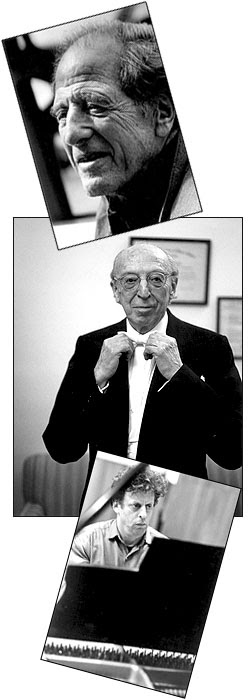
Over the years, Irene Haupt has captured the images of some of the most significant composers and performers of the past quarter century—many of whom have performed at UB or were on the faculty or lectured in the university’s Department of Music. The list includes such renowned names as Åaron Copeland. Jan Williams. Lukas Foss. Philip Glass and John Cage, among others.
Some of the most significant composers and performers of the past quarter century, including (from top) Lukas Foss, Aaron Copeland and Philip Glass, have performed or taught at UB.
A UB alumna herself, Haupt has become, in effect, the unofficial photographer of the music department and its annual June in Buffalo new music festival, recording what has become a visual history of the arts and music scene in Buffalo since the 1970s.
She has teamed up with the UB Music Library to exhibit more than 30 of her music photographs, as well as some personal photographs. “The Photography of Irene Haupt” will be on display in the music library, 104 Baird Hall, North Campus, through Jan. 14.
Her collection of composer photos, including an entire case devoted to Leo Smit, a UB composer and musician, and dear friend to Haupt, features some of the subjects in casual poses. The photographer says she likes to catch her subjects off guard and show their “inner qualities.” “They are more themselves when they are done performing,” she notes.
Haupt, who graduated from the UB art department magna cum laude in 1979 and began taking photographs of the Buffalo arts scene in 1976, recalls the magnetism of the exotic musical hub of UB during that decade. She points out that it was much more experimental and free than today.
“This cellist, Charlotte Mormon, performed nude in a plastic bag, and I remember at Kleinhans, they just had metronomes ticking for two hours by themselves on a stage,” she says.
Haupt hopes the exhibit will enrich students’ knowledge of UB history.
“It shows students what fabulous composers have gone through the university,” she says. “Students should know the richness of the history of the music department and June in Buffalo.”
The exhibition also features some of Haupt’s personal photographs, which at times appear to be three dimensional, causing the viewer to almost visually peel back layers. Her portraits pop out from the paper, also capturing different sides, or layers, of humanity.
Haupt says she purposely creates this effect, viewing her work as a compression of time and experience. She says she looks to such writers as James Joyce, as well as to composers, who layer sounds, rhythms and words into their works for inspiration. The photographs provide what she describes as “a kind of elusive alchemy, the results of which are not predictable, but a divination of a more complex reality.”
Haupt says she’s also influenced by a German female theater photographer, Rosemarie Clausen, who documented actors’ energy in such shows as “Faust.” She likes films from the 1930s, particularly those directed by Jean Cocteau, like “Obvious” and “Belle et le Bête” or “Beauty and the Beast.”
“These were life-changing movies,” Haupt says. “If you see the movies, you will understand my photos. They are very dream-like, black and white movies.”
Some of Haupt’s haunting photos include misty scenes of boats that she created with just small wooden vessels the size of a hand.
“The ideas for the photos just came to me,” Haupt remembers. “The boat against the waves reminds me of the soul going through consciousness and unconsciousness, creating its own meaning of life.”
John Bewley, associate librarian/archivist in the Music Library, notes that the idea for a Haupt exhibition was “sort of on the radar for a while,” and its opening in September was perfectly timed for Gender Week.
Bewley says the music department is working to digitize Haupt’s entire collection of UB music photos—a collection of between 400 and 500 photos—and make it available online by next year.
Haupt’s photos have appeared on many record jackets and book covers, as well as in more than 50 exhibits in such venues as the Burchfield-Penney Arts Center at Buffalo State College, the Castellani Art Museum at Niagara University, CEPA Gallery, the Albright-Knox Art Gallery and Art Dialogue.
Haupt also has worked for almost all of the theaters in Buffalo—at present she is taking photographs for the Irish Classical Theater.
Her photography has been mentioned in such national publications such as The New York Timesand Time magazine, and television shows like “60 Minutes.”